
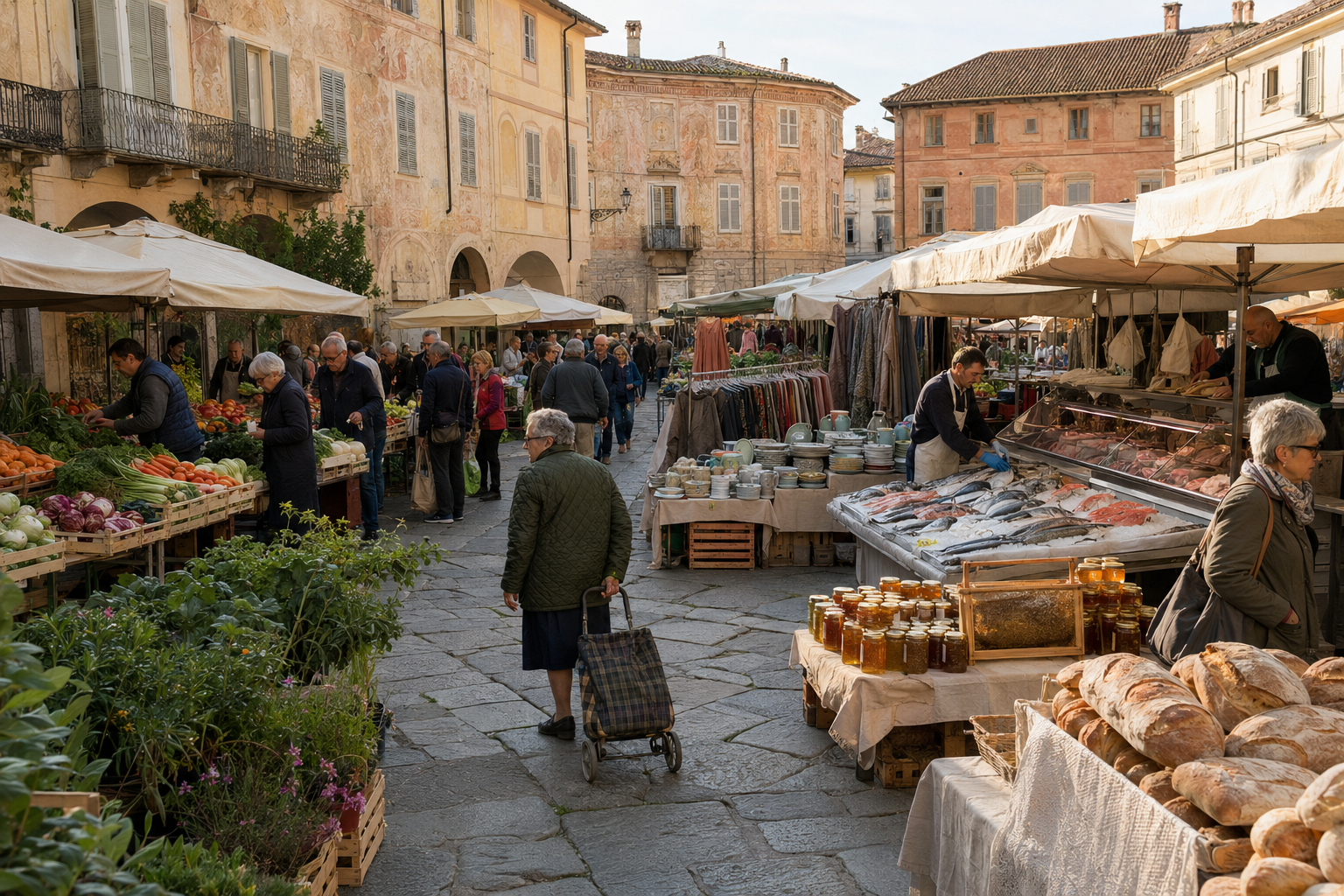
A tradition at the centre of town
In many Italian towns, market day is a familiar appointment. Where the central piazza is large enough—and the population can support it—the square or nearby streets may host a market once a week. Larger centres sometimes have two market days, perhaps a Saturday and another morning during the week, but the calendar is entirely local.
For a few hours, an ordinary square changes character. Canvas awnings appear, crates are opened and people arrive not only to buy what they need, but to take part in a ritual that has accompanied town life for generations.
From the countryside to the shopping bag
Seasonal fruit, vegetables and herbs may come from local growers; beekeepers bring honey and other products from the hive; bakers, butchers and fishmongers add bread, meat and fish. Plants and flowers often sit beside stalls selling clothes, linens, kitchen utensils and practical household goods.
Every market develops its own recognisable mixture and many stallholders return to the same place each week. For residents, this continuity matters: they learn who grows a particular tomato, who brings the bread they prefer and which counter is known for careful quality. Origin, seasonality and availability still vary, so it is always sensible to ask the seller rather than assume every product is local.
A trolley full of shopping—and conversation
Older residents often arrive with a carrellino della spesa, the small wheeled shopping trolley that carries purchases home without placing all the weight in their hands. It is an ordinary, practical object and one of the most familiar sights of market morning.
The market is also social. Neighbours meet between the stalls, exchange news and stop for conversations that may last longer than the shopping itself. Seeing the same sellers and the same fellow residents week after week gives the market a rhythm that a simple shop visit rarely has.
Read the signs before you park
On market day, parking and vehicle access are often restricted in the square and in selected nearby streets. The relevant day and hours are normally shown on temporary or permanent road signs. Leaving a car in the market area during the restricted period can lead to a fine and, where indicated, removal of the vehicle.
If the signs are unclear, ask the Comune or the Polizia Locale before parking. It is also worth checking the official municipal calendar, especially around public holidays, when the normal market day may move or be cancelled. Arriving on foot with a shopping bag—or your own carrellino—is often the simplest way to enjoy the morning.
Sources and editorial note
The article is written in original language for My Private Property Care. Sources support the factual context; no source text has been reproduced.
- Original editorial image and local observationThis article describes common market-day customs observed in Italy. Days, frequency, products, parking restrictions and enforcement vary by municipality and must be checked locally. The opening image was created specifically for My Private Property Care and does not reproduce a third-party photograph.