
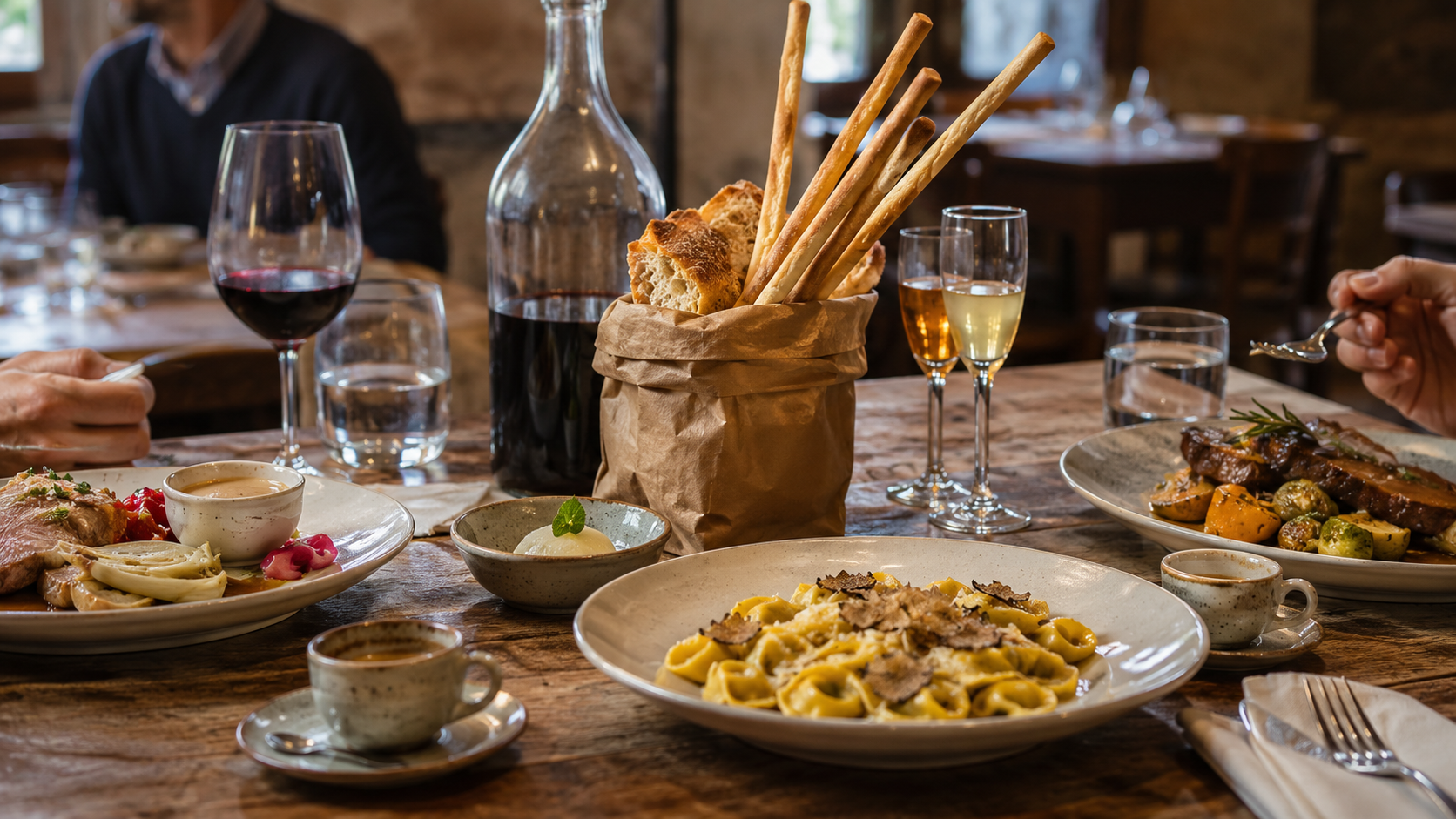
Alla carta—or the pleasure of a fixed menu
In many restaurants around Piedmont, ordering alla carta is only one possibility. It is equally common to find a fixed menu, sometimes with a choice between several dishes. This can be a more convenient way to eat out and, at its best, a gentle tasting journey through the specialities of the area.
A fixed menu may offer an antipasto—the opening of the meal—followed by a primo, a secondo with its contorno, and coffee. Water and wine may be included or charged separately. There is no need to guess: the menu should indicate what the stated price includes, and it is always perfectly natural to ask before ordering.
The order of the table
The familiar sequence is antipasti, primi, secondi and contorni, but this is a framework rather than an obligation to order everything. Antipasti introduce the table; primi often centre on pasta, rice, soup or gnocchi; secondi bring meat, fish, eggs or another main preparation, while vegetables and other side dishes usually appear as contorni.
At home, the same vocabulary survives even when the meal is simpler. A family lunch may not contain every course, yet Italians still distinguish the primo from the secondo and know that the salad or vegetables beside it belong to another small chapter of the meal.
When you think it is finished
Then comes the part that surprises many visitors. After all those courses there may still be dessert, a refreshing sorbet and coffee. And after coffee, the waiter may ask whether you would like an ammazzacaffè: the small after-dinner liqueur that closes the meal. Amaro, limoncello, mirto, liquorice liqueur, amaretto or rucolino are only a few possibilities in a world that changes with region, restaurant and household.
You never have to accept every invitation. The charm is simply that the Italian table rarely ends abruptly. Just when you think the meal is complete, someone asks, with perfect seriousness, whether you might like something else.
The quiet company of bread, grissini and coperto
Especially in Piedmont, a basket or paper bag often arrives with bread and grissini. These long, crisp breadsticks are dangerously easy to eat while waiting for the ordered dishes; they have a talent for waking an unexpected appetite rather than merely calming it.
You may also see a separate coperto on the bill. It is a per-person table charge associated with setting and preparing the place and with the service and cleaning of plates, cutlery, tablecloths and napkins; it is not a tip for the waiter. In many everyday restaurants it is commonly around €2–€2.50 per person, while in particularly elegant establishments it may exceed €5. The amount should be stated on the menu, so it is always worth checking rather than assuming.
Bread and grissini are not merely decoration. They are part of the table’s rhythm: something to share, break and nibble while conversation begins. How bread and coperto are charged can vary from one restaurant to another, and the menu remains the best guide.
Sources and editorial note
The article is written in original language for My Private Property Care. Sources support the factual context; no source text has been reproduced.
- Visit Piemonte — Piedmont’s food culture and grissini ↗
- Visit Piemonte — traditional Piedmontese bread and Stirato Torinese grissini ↗
- Original editorial image and local observationThe article describes common restaurant and household customs observed in Piedmont and elsewhere in Italy. Menus, inclusions, service customs and digestifs vary by establishment and region. The opening image was created specifically for My Private Property Care and does not reproduce a third-party photograph.